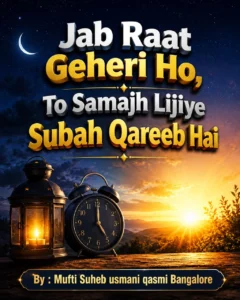
Jab Raat Geheri Ho, To Samajh Lijiye Subah Qareeb Hai
Jis tarah raat ke gehre andhere ke baad subah ka ujala yaqini hai, bilkul isi tarah aap ke is kathan waqt ke baad be-hisaab khushiyan tay hain, In Shaa Allah.
Ghap Andhere Mein Aankhon Ka Imtihaan
Zara tasawwur kijiye, aap ek roshan jagah se achanak ek aise kamre mein daakhil hote hain jahan bilkul ghap andhera ho. Pehle qadam par aap ruk jaate hain. Aankhen khuli hoti hain, magar kuch dikhai nahin deta. Chand lamhon ke liye aisa mehsoos hota hai jaise aankhon ne kaam karna chhor diya ho.
Lekin haqeeqat mein aankhen kaam karna nahin chhortin.
Un ke andar ek qudrati amal shuru ho jata hai jise science mein Dark Adaptation kaha jata hai. Aankhen aahista aahista andhere ke mutabiq khud ko dhaalti hain, hassasiyat barhti hai aur kuch waqt guzarne ke baad woh cheezen bhi dikhai dene lagti hain jo ibtida mein bilkul nazar nahin aa rahi thin.
Yeh manzar zindagi ke kathan waqt ko samajhne ke liye ek gehra sabaq apne andar rakhta hai.
Baaz auqaat insaan aazmaish ke andhere mein daakhil hote hi ghabra jata hai. Use lagta hai ke raasta khatam ho gaya, mustaqbil dikhai nahin de raha, koi umeed baqi nahin rahi.
Haalan-ke mumkin hai ke isi waqt us ke andar ek nai baseerat paida ho rahi ho.
Jaise aankh andhere mein aahista aahista dekhna seekhti hai, waise hi baaz aazmaaishein insaan ko woh cheezen dekhna sikhati hain jo aasani ke zamane mein use dikhai nahin detin.
Woh apni kamzori pehchanta hai.
Apne Rab ko pehchanta hai.
Logon aur Allah ke sahare mein farq samajhta hai.
Aur yeh jaan leta hai ke jise woh apni taqat samajh raha tha, asal taqat us ke paas nahin, us ke Rab ke paas hai.
Is liye har andhera insaan ko andha karne nahin aata; baaz andhere insaan ki aankhen kholne aate hain.
Kabhi Beej Dafan Nahin Hota, Tayyar Ho Raha Hota Hai
Ek beej ko haath mein le kar dekhiye.
Agar use mitti ke neeche dafan kar diya jaye to upar se dekhne wala yahi kahega ke yeh beej kahan gaya? Woh to mitti mein dab gaya, khatam ho gaya.
Lekin baaghbaan jaanta hai ke yeh dafan hona ikhtitaam nahin, aaghaz hai.
Nam mitti ke andar beej ka bairuni khol toot-ta hai. Us ke andar se jarr nikalti hai, phir ek nanhi si konpal apne liye raasta banati hai. Woh andheri mitti ko cheerti hui upar aati hai aur ek din wohi chhota sa beej ek shaadaab, sabz aur phaldaar darakht ban jata hai.
“Momin ka muamla bhi ajeeb hai, us ka har muamla us ke liye khair hi khair hai, aur yeh baat momin ke alawa kisi aur ke liye nahin. Agar use khushi pahunchti hai to woh shukr karta hai, pas woh us ke liye khair ban jati hai, aur agar use takleef pahunchti hai to woh sabr karta hai, pas woh bhi us ke liye khair ban jati hai.”
(Sahih Muslim, Hadith: 2999)
Momin ki zindagi mein koi kaifiyat aisi nahin jis se woh Allah se door hone ke bajaye Allah ke qareeb na ho sakta ho.
Khushi aaye to shukr.
Takleef aaye to sabr.
Aur dono haalat mein banda apne Rab se juda rahe to dono us ke liye khair ban jati hain.
Taif Ki Galiyan: Jahan Patthar Baras Rahe The
Ab zara Seerat-e-Tayyibah ka woh manzar apne dil mein laaiye jise padhte hue aaj bhi dil kaanp uthta hai.
Makkah Mukarramah mein musalsal mukhalifat, Ahl-e-Makkah ki aziyyaten, Hazrat Khadijah رضی اللہ عنہا aur Hazrat Abu Talib ki wafat, aur phir da‘wat-e-Islam ke liye Taif ka safar.
Rasoolullah ﷺ Taif tashreef le gaye ke shayad wahan ke log Allah ka paigham qubool kar lein, magar wahan bhi Aap ﷺ ko woh qubooliyat na mili jis ki umeed thi.
Logon ne sirf inkaar nahin kiya, balke ochaq logon ko Aap ﷺ ke peeche laga diya. Unhon ne patthar maare yahan tak ke Aap ﷺ ke qadam-e-mubarak lahu-luhan ho gaye.
Soochiye!
Ek insaan jis ne apni qaum ke liye khair chahi, isi qaum ke baad doosri basti mein gaya, aur wahan bhi pattharon ke saath isteqbaal hua.
Ba-zahir har taraf andhera tha.
Lekin isi mauqe par Rasoolullah ﷺ ne Allah Ta‘ala ke saamne apna dard pesh kiya.
Taif ki takleef is waqee‘e ka ek aisa marhala thi jis ke baad Seerat-e-Nabawi ﷺ mein Isra aur Mi‘raj ka azeem waqia pesh aaya, aur phir hijrat ke baad Madinah Munawwarah woh markaz bana jahan se Islam ki roshni poori duniya tak pahunchi.
Taif ke patthar aakhri manzar nahin the.
Woh ek aise safar ki ek dardnaak manzil the jis ke aage Allah Ta‘ala ki azeem nusratain likhi thin.
Yahan insaan ke liye ek bada sabaq hai:
Aaj ka patthar kal ki bunyaad bhi ban sakta hai.
Aaj ka zakhm kal ki hikmat ban sakta hai.
Aaj ki tanhaai kal ki da‘wat ka raasta ban sakti hai.
Aur aaj ka aansu kal ki muskurahat ki qeemat ban sakta hai.
Jab Insaan Kehta Hai: “Ab Mere Liye Kuch Nahin Bacha”
Aise waqt mein insaan ko apne dil ke andar ek sawaal zaroor paida karna chahiye:
“Kya main sirf mojooda lamha dekh raha hoon, ya apne Rab ke poore faisle par imaan bhi rakhta hoon?”
Hazrat Ya‘qub علیہ السلام ne Hazrat Yusuf علیہ السلام ki judaai mein taweel gham bardasht kiya. Aankhen gham se safed ho gayin, magar Allah ki rahmat se umeed khatam nahin hui.
“Aye mere beto! Jao, Yusuf aur us ke bhai ki talaash karo aur Allah ki rahmat se na-umeed na hona, be-shak Allah ki rahmat se sirf kafir log hi na-umeed hote hain.”
(Surah Yusuf, 12:87)
Yeh aayat gham-zadah dil ke liye umeed ka charagh hai.
Mushkil kitni hi taweel ho, Allah ki rahmat se na-umeedi momin ka raasta nahin.
Apni Taaqat Se Zyada Bojh Nahin
Jab aazmaish lambi ho jati hai to insaan kabhi khud hi faisla kar leta hai:
“Allah kisi jaan ko us ki taqat se zyada takleef nahin deta. Jo neki woh karegi us ka faida isi ko hoga aur jo burai woh karegi us ka wabaal bhi isi par hoga. Aye hamare Rab! Agar hum bhool jayen ya hum se khata ho jaye to hamein na pakarna. Aye hamare Rab! Hum par aisa bojh na daalna jaisa hum se pehle logon par dala tha. Aye hamare Rab! Hum par woh bojh na daalna jis ki hamein taqat na ho, aur hamein maaf farma, hamein bakhsh de aur hum par rahm farma. Tu hi hamara Maula hai, pas kafiron ke muqable mein hamari madad farma.”
(Surah Al-Baqarah, 2:286)
Is ka matlab yeh nahin ke insaan takleef ko mamooli samjhe.
Balke yeh yaqeen rakhe ke jis Rab ne use is aazmaish mein rakha hai, wohi use is se nikalne ka raasta bhi ata kar sakta hai.
Sabr Ka Matlab Bebasi Nahin
Rasoolullah ﷺ ne Hazrat Abdullah bin Abbas رضی اللہ عنہما ko farmaya:
“Aye bachche! Main tumhein chand baatein sikhata hoon: Allah ki hifazat karo, Allah tumhari hifazat farmayega. Allah ki hifazat karo, tum use apne saamne paoge. Jab maango to Allah hi se maango, aur jab madad chaho to Allah hi se madad chaho. Aur jaan lo ke agar poori ummat is baat par jama ho jaye ke tumhein koi faida pahunchaye to woh tumhein is se zyada faida nahin pahuncha sakti jo Allah ne tumhare liye likh diya hai, aur agar sab log mil kar tumhein nuqsan pahunchana chahein to woh tumhein is se zyada nuqsan nahin pahuncha sakte jo Allah ne tumhare liye likh diya hai. Qalam utha diye gaye aur sahife khushk ho chuke.”
(Jami‘ At-Tirmidhi, Hadith: 2516)
Is liye sabr ka matlab yeh nahin ke insaan koshish chhor de.
Sabr yeh hai ke mushkil mein bhi namaz na chhoote, dua na chhoote, halal koshish na chhoote, aur Allah se umeed na toote.
Aaj Ki Mushkil Kal Ki Hikmat Ban Sakti Hai
Kabhi karobaar ka nuqsan insaan ko un logon se door kar deta hai jinhein woh apna samajhta tha.
Kabhi beemari insaan ko woh namazen padha deti hai jo sehat ke dinon mein chhoot jati thin.
Kabhi tanhaai insaan ko Qur’an ke qareeb le aati hai.
Kabhi kisi ka chhor jana insaan ko Allah ke saath aisa ta‘alluq de jata hai jo duniya ki koi mohabbat nahin de sakti.
Aur kabhi ek nakaami insaan ko us raaste par daal deti hai jahan woh apni asal salahiyat pehchan leta hai.
Is liye har waqee‘e ka faisla isi waqt na kijiye.
Baaz kahaniyan darmiyan mein bahut dardnaak hoti hain, magar un ka ikhtitaam bahut khoobsurat hota hai.
Beej jab mitti mein jata hai to use kuch arse ke liye aasman dikhai nahin deta.
Us ke upar mitti hoti hai.
Us ke ird-gird andhera hota hai.
Us par dabao hota hai.
Magar woh isi haalat mein apne andar ki quwwat ko istemal karta hai.
Phir ek din woh mitti ko cheer kar bahar aata hai.
Insaan ki zindagi mein bhi kabhi aisa marhala aata hai jab use lagta hai ke woh chaaron taraf se dab gaya hai.
Lekin agar woh us waqt Allah se juda rahe, to mumkin hai yahi dabao us ke andar ki woh quwwat paida kar de jo aaraam ki zindagi kabhi paida na kar sakti.
Isi liye aaj agar zindagi ka andhera bahut gehra hai to sirf yeh na dekhiye ke abhi kya nazar aa raha hai.
Yeh bhi sochiye ke shayad Allah Ta‘ala aap ke andar kuch aisa paida kar rahe hain jo is waqt aap ki nigah se posheeda hai.
Aur shayad woh subah, jis ke liye aap ro rahe hain, aap ke tasawwur se bhi zyada qareeb ho.
Jis tarah raat ke gehre andhere ke baad subah ka ujala yaqini hai, bilkul isi tarah aap ke is kathan waqt ke baad be-hisaab khushiyan tay hain, In Shaa Allah.
Bas apne Rab se ta‘alluq na tootne dijiye; kyun-ke kabhi kabhi insaan jis raat ko apni zindagi ki sab se badi tareeki samajh kar ro raha hota hai, isi raat ke aakhri pehar Allah Ta‘ala us subah ka faisla likh chuke hote hain jis ke ujale mein woh apne guzre hue aansuon ko bhi rahmat samajh kar dekhega.
جب رات گہری ہو، تو سمجھ لیجیے صبح قریب ہے
جس طرح رات کے گہرے اندھیرے کے بعد صبح کا اجالا یقینی ہے، بالکل اسی طرح آپ کے اس کٹھن وقت کے بعد بے حساب خوشیاں طے ہیں، ان شاء اللہ۔
گھپ اندھیرے میں آنکھوں کا امتحان
ذرا تصور کیجیے، آپ ایک روشن جگہ سے اچانک ایک ایسے کمرے میں داخل ہوتے ہیں جہاں بالکل گھپ اندھیرا ہو۔ پہلے قدم پر آپ رک جاتے ہیں۔ آنکھیں کھلی ہوتی ہیں، مگر کچھ دکھائی نہیں دیتا۔ چند لمحوں کے لیے ایسا محسوس ہوتا ہے جیسے آنکھوں نے کام کرنا چھوڑ دیا ہو۔
لیکن حقیقت میں آنکھیں کام کرنا نہیں چھوڑتیں۔
ان کے اندر ایک قدرتی عمل شروع ہو جاتا ہے جسے سائنس میں Dark Adaptation کہا جاتا ہے۔ آنکھیں آہستہ آہستہ اندھیرے کے مطابق خود کو ڈھالتی ہیں، حساسیت بڑھتی ہے اور کچھ وقت گزرنے کے بعد وہ چیزیں بھی دکھائی دینے لگتی ہیں جو ابتدا میں بالکل نظر نہیں آ رہی تھیں۔
یہ منظر زندگی کے کٹھن وقت کو سمجھنے کے لیے ایک گہرا سبق اپنے اندر رکھتا ہے۔
بعض اوقات انسان آزمائش کے اندھیرے میں داخل ہوتے ہی گھبرا جاتا ہے۔ اسے لگتا ہے کہ راستہ ختم ہوگیا، مستقبل دکھائی نہیں دے رہا، کوئی امید باقی نہیں رہی۔
حالانکہ ممکن ہے کہ اسی وقت اس کے اندر ایک نئی بصیرت پیدا ہو رہی ہو۔
جیسے آنکھ اندھیرے میں آہستہ آہستہ دیکھنا سیکھتی ہے، ویسے ہی بعض آزمائشیں انسان کو وہ چیزیں دیکھنا سکھاتی ہیں جو آسانی کے زمانے میں اسے دکھائی نہیں دیتیں۔
وہ اپنی کمزوری پہچانتا ہے۔
اپنے رب کو پہچانتا ہے۔
لوگوں اور اللہ کے سہارے میں فرق سمجھتا ہے۔
اور یہ جان لیتا ہے کہ جسے وہ اپنی طاقت سمجھ رہا تھا، اصل طاقت اس کے پاس نہیں، اس کے رب کے پاس ہے۔
اس لیے ہر اندھیرا انسان کو اندھا کرنے نہیں آتا؛ بعض اندھیرے انسان کی آنکھیں کھولنے آتے ہیں۔
کبھی بیج دفن نہیں ہوتا، تیار ہو رہا ہوتا ہے
ایک بیج کو ہاتھ میں لے کر دیکھیے۔
اگر اسے مٹی کے نیچے دفن کر دیا جائے تو اوپر سے دیکھنے والا یہی کہے گا کہ یہ بیج کہاں گیا؟ وہ تو مٹی میں دب گیا، ختم ہوگیا۔
لیکن باغبان جانتا ہے کہ یہ دفن ہونا اختتام نہیں، آغاز ہے۔
نم مٹی کے اندر بیج کا بیرونی خول ٹوٹتا ہے۔ اس کے اندر سے جڑ نکلتی ہے، پھر ایک ننھی سی کونپل اپنے لیے راستہ بناتی ہے۔ وہ اندھیری مٹی کو چیرتی ہوئی اوپر آتی ہے اور ایک دن وہی چھوٹا سا بیج ایک شاداب، سبز اور پھل دار درخت بن جاتا ہے۔
زندگی میں بعض مشکلات بھی اسی طرح آتی ہیں۔
انسان کہتا ہے:
“میں دب گیا ہوں۔”
مگر ممکن ہے اللہ تعالیٰ کے فیصلے میں ہو:
“تمہاری صلاحیت کا خول ٹوٹ رہا ہے۔”
انسان کہتا ہے:
“میرا راستہ بند ہوگیا۔”
ممکن ہے اسی بندش کے اندر نئی جڑیں مضبوط ہو رہی ہوں۔
انسان کہتا ہے:
“یہ مصیبت مجھے ختم کر دے گی۔”
اور وقت گزرنے کے بعد اسے معلوم ہوتا ہے کہ اسی مصیبت نے اسے وہ انسان بنا دیا جس کی اسے خود بھی خبر نہیں تھی۔
کبھی اللہ تعالیٰ انسان کو آسانی سے نہیں، آزمائش سے بڑا بناتے ہیں۔
کبھی سکون انسان کو نہیں بناتا، صبر بناتا ہے۔
کبھی کامیابی انسان کو نہیں سنوارتی، ناکامی اسے اپنے رب کے سامنے جھکنا سکھاتی ہے۔
اسی لیے مشکل کا آنا ہمیشہ نقصان کی علامت نہیں ہوتا۔
“مومن کا معاملہ بھی عجیب ہے، اس کا ہر معاملہ اس کے لیے خیر ہی خیر ہے، اور یہ بات مومن کے علاوہ کسی اور کے لیے نہیں۔ اگر اسے خوشی پہنچتی ہے تو وہ شکر کرتا ہے، پس وہ اس کے لیے خیر بن جاتی ہے، اور اگر اسے تکلیف پہنچتی ہے تو وہ صبر کرتا ہے، پس وہ بھی اس کے لیے خیر بن جاتی ہے۔”
(صحیح مسلم، حدیث: 2999)
مومن کی زندگی میں کوئی کیفیت ایسی نہیں جس سے وہ اللہ سے دور ہونے کے بجائے اللہ کے قریب نہ ہوسکتا ہو۔
خوشی آئے تو شکر۔
تکلیف آئے تو صبر۔
اور دونوں حالتوں میں بندہ اپنے رب سے جڑا رہے تو دونوں اس کے لیے خیر بن جاتی ہیں۔
طائف کی گلیاں: جہاں پتھر برس رہے تھے
اب ذرا سیرتِ طیبہ کا وہ منظر اپنے دل میں لائیے جسے پڑھتے ہوئے آج بھی دل کانپ اٹھتا ہے۔
مکہ مکرمہ میں مسلسل مخالفت، اہلِ مکہ کی اذیتیں، حضرت خدیجہ رضی اللہ عنہا اور حضرت ابو طالب کی وفات، اور پھر دعوتِ اسلام کے لیے طائف کا سفر۔
رسول اللہ ﷺ طائف تشریف لے گئے کہ شاید وہاں کے لوگ اللہ کا پیغام قبول کرلیں، مگر وہاں بھی آپ ﷺ کو وہ قبولیت نہ ملی جس کی امید تھی۔
لوگوں نے صرف انکار نہیں کیا، بلکہ اوباش لوگوں کو آپ ﷺ کے پیچھے لگا دیا۔ انہوں نے پتھر مارے یہاں تک کہ آپ ﷺ کے قدم مبارک لہولہان ہوگئے۔
سوچیے!
ایک انسان جس نے اپنی قوم کے لیے خیر چاہی، اسی قوم کے بعد دوسری بستی میں گیا، اور وہاں بھی پتھروں کے ساتھ استقبال ہوا۔
بظاہر ہر طرف اندھیرا تھا۔
لیکن اسی موقع پر رسول اللہ ﷺ نے اللہ تعالیٰ کے سامنے اپنا درد پیش کیا۔
طائف کی تکلیف اس واقعے کا ایک ایسا مرحلہ تھی جس کے بعد سیرتِ نبوی ﷺ میں اسراء و معراج کا عظیم واقعہ پیش آیا، اور پھر ہجرت کے بعد مدینہ منورہ وہ مرکز بنا جہاں سے اسلام کی روشنی پوری دنیا تک پہنچی۔
طائف کے پتھر آخری منظر نہیں تھے۔
وہ ایک ایسے سفر کی ایک دردناک منزل تھے جس کے آگے اللہ تعالیٰ کی عظیم نصرتیں لکھی تھیں۔
یہاں انسان کے لیے ایک بڑا سبق ہے:
آج کا پتھر کل کی بنیاد بھی بن سکتا ہے۔
آج کا زخم کل کی حکمت بن سکتا ہے۔
آج کی تنہائی کل کی دعوت کا راستہ بن سکتی ہے۔
اور آج کا آنسو کل کی مسکراہٹ کی قیمت بن سکتا ہے۔
جب انسان کہتا ہے: “اب میرے لیے کچھ نہیں بچا”
ایسے وقت میں انسان کو اپنے دل کے اندر ایک سوال ضرور پیدا کرنا چاہیے:
“کیا میں صرف موجودہ لمحہ دیکھ رہا ہوں، یا اپنے رب کے پورے فیصلے پر ایمان بھی رکھتا ہوں؟”
حضرت یعقوب علیہ السلام نے حضرت یوسف علیہ السلام کی جدائی میں طویل غم برداشت کیا۔ آنکھیں غم سے سفید ہوگئیں، مگر اللہ کی رحمت سے امید ختم نہیں ہوئی۔
“اللہ کسی جان کو اس کی طاقت سے زیادہ تکلیف نہیں دیتا۔ جو نیکی وہ کرے گی اس کا فائدہ اسی کو ہوگا اور جو برائی وہ کرے گی اس کا وبال بھی اسی پر ہوگا۔ اے ہمارے رب! اگر ہم بھول جائیں یا ہم سے خطا ہو جائے تو ہمیں نہ پکڑنا۔ اے ہمارے رب! ہم پر ایسا بوجھ نہ ڈالنا جیسا ہم سے پہلے لوگوں پر ڈالا تھا۔ اے ہمارے رب! ہم پر وہ بوجھ نہ ڈالنا جس کی ہمیں طاقت نہ ہو، اور ہمیں معاف فرما، ہمیں بخش دے اور ہم پر رحم فرما۔ تو ہی ہمارا مولیٰ ہے، پس کافروں کے مقابلے میں ہماری مدد فرما۔”
(سورۃ البقرۃ، 2:286)
اس کا مطلب یہ نہیں کہ انسان تکلیف کو معمولی سمجھے۔
بلکہ یہ یقین رکھے کہ جس رب نے اسے اس آزمائش میں رکھا ہے، وہی اسے اس سے نکلنے کا راستہ بھی عطا کرسکتا ہے۔
صبر کا مطلب بے بسی نہیں
رسول اللہ ﷺ نے حضرت عبداللہ بن عباس رضی اللہ عنہما کو فرمایا:
“اے بچے! میں تمہیں چند باتیں سکھاتا ہوں: اللہ کی حفاظت کرو، اللہ تمہاری حفاظت فرمائے گا۔ اللہ کی حفاظت کرو، تم اسے اپنے سامنے پاؤ گے۔ جب مانگو تو اللہ ہی سے مانگو، اور جب مدد چاہو تو اللہ ہی سے مدد چاہو۔ اور جان لو کہ اگر پوری امت اس بات پر جمع ہوجائے کہ تمہیں کوئی فائدہ پہنچائے تو وہ تمہیں اس سے زیادہ فائدہ نہیں پہنچا سکتی جو اللہ نے تمہارے لیے لکھ دیا ہے، اور اگر سب لوگ مل کر تمہیں نقصان پہنچانا چاہیں تو وہ تمہیں اس سے زیادہ نقصان نہیں پہنچا سکتے جو اللہ نے تمہارے لیے لکھ دیا ہے۔ قلم اٹھا دیے گئے اور صحیفے خشک ہوچکے۔”
(جامع الترمذی، حدیث: 2516)
اس لیے صبر کا مطلب یہ نہیں کہ انسان کوشش چھوڑ دے۔
صبر یہ ہے کہ مشکل میں بھی نماز نہ چھوٹے، دعا نہ چھوٹے، حلال کوشش نہ چھوٹے، اور اللہ سے امید نہ ٹوٹے۔
آج کی مشکل کل کی حکمت بن سکتی ہے
کبھی کاروبار کا نقصان انسان کو ان لوگوں سے دور کر دیتا ہے جنہیں وہ اپنا سمجھتا تھا۔
کبھی بیماری انسان کو وہ نمازیں پڑھا دیتی ہے جو صحت کے دنوں میں چھوٹ جاتی تھیں۔
کبھی تنہائی انسان کو قرآن کے قریب لے آتی ہے۔
کبھی کسی کا چھوڑ جانا انسان کو اللہ کے ساتھ ایسا تعلق دے جاتا ہے جو دنیا کی کوئی محبت نہیں دے سکتی۔
اور کبھی ایک ناکامی انسان کو اس راستے پر ڈال دیتی ہے جہاں وہ اپنی اصل صلاحیت پہچان لیتا ہے۔
اس لیے ہر واقعے کا فیصلہ اسی وقت نہ کیجیے۔
بعض کہانیاں درمیان میں بہت دردناک ہوتی ہیں، مگر ان کا اختتام بہت خوبصورت ہوتا ہے۔
اندھیری مٹی، ٹوٹا ہوا بیج، اور آنے والا درخت
بیج جب مٹی میں جاتا ہے تو اسے کچھ عرصے کے لیے آسمان دکھائی نہیں دیتا۔
اس کے اوپر مٹی ہوتی ہے۔
اس کے اردگرد اندھیرا ہوتا ہے۔
اس پر دباؤ ہوتا ہے۔
مگر وہ اسی حالت میں اپنے اندر کی قوت کو استعمال کرتا ہے۔
پھر ایک دن وہ مٹی کو چیر کر باہر آتا ہے۔
انسان کی زندگی میں بھی کبھی ایسا مرحلہ آتا ہے جب اسے لگتا ہے کہ وہ چاروں طرف سے دب گیا ہے۔
لیکن اگر وہ اس وقت اللہ سے جڑا رہے، تو ممکن ہے یہی دباؤ اس کے اندر کی وہ قوت پیدا کردے جو آرام کی زندگی کبھی پیدا نہ کرسکتی۔
اسی لیے آج اگر زندگی کا اندھیرا بہت گہرا ہے تو صرف یہ نہ دیکھیے کہ ابھی کیا نظر آرہا ہے۔
یہ بھی سوچیے کہ شاید اللہ تعالیٰ آپ کے اندر کچھ ایسا پیدا کر رہے ہیں جو اس وقت آپ کی نگاہ سے پوشیدہ ہے۔
اور شاید وہ صبح، جس کے لیے آپ رو رہے ہیں، آپ کے تصور سے بھی زیادہ قریب ہو۔
جس طرح رات کے گہرے اندھیرے کے بعد صبح کا اجالا یقینی ہے، بالکل اسی طرح آپ کے اس کٹھن وقت کے بعد بے حساب خوشیاں طے ہیں، ان شاء اللہ۔
بس اپنے رب سے تعلق نہ ٹوٹنے دیجیے؛ کیونکہ کبھی کبھی انسان جس رات کو اپنی زندگی کی سب سے بڑی تاریکی سمجھ کر رو رہا ہوتا ہے، اسی رات کے آخری پہر اللہ تعالیٰ اس صبح کا فیصلہ لکھ چکے ہوتے ہیں جس کے اجالے میں وہ اپنے گزرے ہوئے آنسوؤں کو بھی رحمت سمجھ کر دیکھے گا۔
When the Night Is at Its Darkest, Know That Morning Is Near
Just as the deepest darkness of the night is always followed by the light of morning, in the same way, after this difficult time you are going through, better days and countless moments of happiness are waiting for you, In Sha Allah.
When Even Your Eyes Need Time to Find the Light
Imagine walking out of a brightly lit room and suddenly entering a room where there is almost complete darkness.
You stop.
Your eyes are open, but you cannot see anything.
For a few moments, you may even feel frightened. You may think, “Where is the door? Where should I put my next step? Is there any way out?”
But something beautiful is happening inside your eyes.
Your eyes have not stopped working.
They are slowly adjusting to the darkness.
Science calls this natural process Dark Adaptation. The eyes gradually become more sensitive to the little light that is available. After some time, things that were completely invisible at first begin to appear.
The room has not necessarily become brighter.
Your eyes have learned how to see in the darkness.
There is a deep lesson here for every person going through a difficult time.
Sometimes a person enters the darkness of a trial and becomes frightened because nothing seems clear.
The future looks empty.
The road ahead seems closed.
Hope feels far away.
But perhaps, at that very moment, something is changing inside you.
Just as the eyes slowly learn to see in darkness, some difficult times teach the heart to see things that were invisible during the easy days.
You begin to understand your own weakness.
You begin to know your Lord.
You learn the difference between depending on people and depending on Allah.
You discover that the strength you thought was yours was never truly yours.
The real strength was always with your Lord.
So remember:
Not every darkness comes to make you blind. Some darkness comes to teach you how to see.
Sometimes a Seed Is Not Buried — It Is Being Prepared
Take a small seed in your hand.
Now imagine putting it deep under the soil.
From above, someone may look at that piece of land and say:
“Where has the seed gone? It has been buried. It has disappeared.”
But the farmer knows something the person standing above the soil does not know.
Being buried is not always the end. Sometimes it is the beginning.
Inside the dark and moist soil, the outer covering of the seed begins to break.
A root begins to grow.
The little seed starts making its way through the earth.
Then one day, a tiny green shoot breaks through the soil.
And after some time, that same little seed becomes a green, strong and fruit-bearing tree.
Life can be like that too.
A person says:
“I am under too much pressure.”
But perhaps, in the plan of Allah:
Your old shell is breaking.
A person says:
“My way is completely closed.”
But perhaps new roots are becoming stronger inside that very closed place.
A person says:
“This hardship will destroy me.”
And years later, that same person may look back and say:
“That hardship made me the person I never knew I could become.”
Sometimes Allah does not make a person stronger through comfort.
He makes him stronger through hardship.
Sometimes comfort does not teach a person patience.
Pain does.
Sometimes success does not make a person humble.
Failure brings him closer to his Lord.
That is why every difficulty is not necessarily a sign of loss.
Sometimes a difficult season is preparing you for a better life.
The Promise of the Qur’an: Hardship Never Comes Alone
“How wonderful is the matter of a believer! Everything that happens to him is good for him, and this is only for the believer. If happiness comes to him, he is thankful, and that is good for him. And if hardship comes to him, he remains patient, and that is also good for him.”
(Sahih Muslim, Hadith: 2999)
Look at the beauty of a believer’s life.
When happiness comes:
He says Alhamdulillah.
When hardship comes:
He holds on to Sabr.
In both situations, he remains connected to Allah.
That is why the believer does not waste either happiness or pain.
He turns happiness into Shukr.
He turns pain into Sabr.
And both bring him closer to his Lord.
Ta’if: The Streets Where Stones Were Falling
Now bring one of the most painful scenes from the Seerah into your heart.
Makkah had become extremely difficult for the Messenger of Allah ﷺ.
There was continuous opposition.
There was rejection.
There was pain.
Then came the loss of two great supports: Hazrat Khadijah رضي الله عنها and Hazrat Abu Talib.
It was a deeply painful period.
Yet the Messenger of Allah ﷺ did not stop.
He travelled to Ta’if with the hope that perhaps its people would listen to the message of Allah and accept the truth.
But Ta’if did not welcome him with open arms.
They rejected him.
And then they sent people after him who attacked him and threw stones at him.
The stones struck his blessed body.
His blessed feet were injured and began to bleed.
Just pause for a moment.
A man who had spent his life wishing goodness for people had come to another town carrying the message of mercy.
And what did he receive?
Stones.
Pain.
Rejection.
Blood.
From the outside, it looked like complete darkness.
But it was not the end of the story.
The pain of Ta’if was followed in the journey of the Seerah by the great honour of Isra and Mi‘raj, and later came the Hijrah to Madinah.
Madinah became the centre from which the light of Islam spread far and wide.
The stones of Ta’if were not the final scene.
They were one painful chapter in a much greater story of Allah’s help and victory.
And there is a lesson here for every heart that is hurting today:
Today’s stone may become tomorrow’s foundation.
Today’s wound may become tomorrow’s wisdom.
Today’s loneliness may prepare the way for tomorrow’s purpose.
And today’s tears may become part of the price you paid for tomorrow’s smile.
When a Person Says, “There Is Nothing Left for Me”
At such a moment, ask yourself one question:
“Am I looking only at this moment, or do I also trust the complete plan of my Lord?”
Hazrat Ya‘qub عليه السلام spent a long time in the pain of separation from Hazrat Yusuf عليه السلام.
His grief was so great that his eyes became white from sorrow.
“My sons, go and search for Yusuf and his brother, and do not lose hope in the mercy of Allah. Surely, no one loses hope in the mercy of Allah except the disbelieving people.”
(Surah Yusuf, 12:87)
For a heart carrying grief, this is not just an Ayah.
It is a light.
It is a hand reaching into the darkness.
It tells the broken heart:
Your pain may be long, but Allah’s mercy is never far.
A difficult season may continue for a while.
But a believer never makes hopelessness his home.
Allah Does Not Place a Burden Beyond Our Strength
When a trial continues for a long time, a person may quietly say to himself:
“Allah does not burden any soul beyond its capacity. It will have the reward of whatever good it has done, and it will bear the result of whatever evil it has done. Our Lord, do not hold us responsible if we forget or make a mistake. Our Lord, do not place upon us a burden like the burden You placed upon those before us. Our Lord, do not place upon us a burden that we do not have the strength to carry. Forgive us, pardon us and have mercy upon us. You are our Protector, so help us against the disbelieving people.”
(Surah Al-Baqarah, 2:286)
This does not mean that pain is always easy.
It does not mean that a believer should pretend that suffering does not hurt.
It means that when you are inside the storm, remember the One who knows your strength better than you know yourself.
The One who allowed the trial to come is also able to open a way out.
Sabr Does Not Mean Giving Up
The Messenger of Allah ﷺ said to Hazrat Abdullah ibn Abbas رضي الله عنهما:
“O young boy, I will teach you some words: Protect Allah’s commands and Allah will protect you. Protect Allah’s commands and you will find Him before you. When you ask, ask Allah. When you seek help, seek help from Allah. Know that if the whole nation came together to benefit you with something, they could not benefit you except with something Allah had already written for you. And if they came together to harm you with something, they could not harm you except with something Allah had already written against you. The pens have been lifted and the pages have dried.”
(Jami‘ at-Tirmidhi, Hadith: 2516)
So Sabr does not mean sitting down and doing nothing.
Sabr means that even in difficulty:
You do not leave Salah.
You do not leave Dua.
You do not leave honest effort.
You do not leave the Halal path.
And above all:
You do not let go of hope in Allah.
Today’s Difficulty May Become Tomorrow’s Wisdom
Sometimes a business loss separates a person from people he once thought would always stand beside him.
Sometimes illness brings a person back to Salah after years of neglect.
Sometimes loneliness takes a person closer to the Qur’an.
Sometimes someone leaving your life teaches you a kind of connection with Allah that no human relationship could ever give.
Sometimes one failure pushes a person onto a path where he finally discovers what he was truly capable of.
That is why you should not judge every event while you are still standing in the middle of it.
You may be reading only one painful page.
Allah knows the whole story.
Some stories are heartbreaking in the middle.
But their ending can be beautiful.
The Dark Soil, the Broken Seed, and the Tree That Has Not Yet Appeared
When a seed enters the soil, for some time it cannot see the sky.
There is soil above it.
Darkness around it.
Pressure over it.
But inside that darkness, something is happening.
The seed is using the strength Allah placed inside it.
Then one day, it breaks through the soil.
Your life may also reach a moment when you feel pressed from every side.
You may feel that there is no space left.
No clear road.
No easy answer.
No visible way out.
But if you remain connected to Allah, that very pressure may produce a strength inside you that a comfortable life could never have produced.
So if the darkness around your life feels very deep today, do not look only at what you can see right now.
Ask yourself:
“Could Allah be preparing something inside me that I cannot see yet?”
Perhaps the morning you are crying for is much closer than you think.
Perhaps the door you cannot see is already being opened.
Perhaps the answer you are waiting for is already on its way.
And perhaps one day you will look back at this very night and say:
“I cried because I thought Allah had forgotten me.
I did not know that He was preparing me.”
Just as the deepest darkness of the night is always followed by the light of morning, in the same way, after this difficult time you are going through, better days and countless moments of happiness are waiting for you, In Sha Allah.
So do not let your connection with your Lord break.
Because sometimes a person spends the darkest night of his life crying, thinking that everything has ended, while in the final hours of that very night, Allah has already written the morning that will one day make those same tears look like a part of His mercy.
And when that morning finally comes, you may not remember the pain with anger anymore.
You may remember it with tears in your eyes and say:
“My Lord, now I understand why You made me wait.”
3 thoughts on “When the Night Is at Its Darkest, Know That Morning Is Near”
Shaikh Meraj
Hazrat LOHOR SE TA KHAKHE BHUKARA WA SAMARKHAD BHOK Roman English me hai to pdf sher kariye naa



Hazrat LOHOR SE TA KHAKHE BHUKARA WA SAMARKHAD BHOK Roman English me hai to pdf sher kariye naa
Nhi hai to fir kaise milge wo bata dijiye
Walla-hi this morning itself I was going through these thoughts that I felt 10/12 years back that how Allah has tested me and my family.